Ptil Techelet
A Mitzvah rediscovered.
What is Tchellet?
If your read closely at Parshat Tzitzit, you'll notice that included in the commandment is putting on a Ptil Techellet - a thread of blue.
Unfortunatly, today most Tzitzit is white.
However, Tchellet is becoming more and more common.
Let's dive in.
Tchellet Dye in a nutshell
Tchellet is a very unique dye accuired from a very special sea creature known by the Gemara as the Chilazon. Tchellet is only Kosher when obtained from the Chilazon and anything else is completely forbidden. In Talmudic times, it was very expensive, worth almost 20 times it's weight in gold! It was a symbol of wealth and power, and while that led it to be chosen to represent our connection with Hashem, it was also it's downfall.
Why was Tchellet so valuble?
Blue is rarely found in nature. For thousands of years, the only colors of cloths were those of their natural materiels - various shades of gray and brown. Slowly, though, different dyes were discovered. Blue, however, had only 3 types natural dyes: Indigo, Woad, and that of the Chilazon. Indigo and Woad, despite being significantly cheaper, both faded over time, leaving the Tchellet of Chilazon the only viable option, as it never faded.
How many of strings do you need for Tchellet?
If you noticed in the source for Tchellet, the Torah is pretty vague on how much Tchellet to put in per corner, merely requiring a "string", resulting in a debate between the Poskim about how many strings are required.
There are three main opinions with regard to how many strings of Tchellet you need:
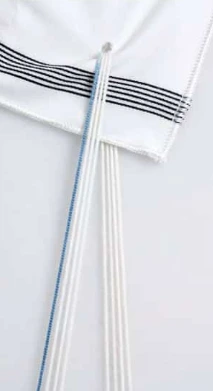
Rambam (1 out of the 8 strings) Raavad (2 out of the 8 strings), and Tosfot (4 out of the 8 strings).
Rambam
The opinion of the Rambam requires only half a string (folded in the corner to make 1) dyed Tchellet, as he interpets the word "Ptil" - fringe, only to mean half a string. The Meshech Chochmah, however, states that it represents the seven days that the Jews left Egypt is represented by the white, and the eighth string of Tchellet represents the day Bnei Yisrael crossed Yam Suf, and Tchellet is likened to the sea. Rav Dov Lior holds that Sfardim should used Rambam. Other notable supporters of this ratio include:
Ben Ish Chai
Rabeinu Bechayei
Meshech Chochmah
ARI"ZL
Rav Rimmon
Raavad
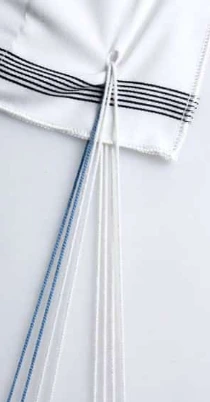
The opinion of the Raavad (Derived from his commentary to the Rambam's Mishnah Torah) requires only one string (folded in the corner to make 2) dyed Tchellet. Despite Rav Shcheter's Psak that people should only follow this ratio when tying GR"A, this is the most widely followed ratio today. Other notable supporters of this ratio include:
GR"A
Chinuch
Aruch
R' Natronoi Gaon
Kaftor VaFerach
Radzyner Rebbi
Tashbetz

Tosfot
The opinion of the Tosfot requires 2 strings (folded at the corner to make 4) dyed Tchellet, as they interpert the passuk that Tzitzit and Tchellet are an equal mitzvah. Therefore, they have an equal amount of strings: 4 regular and 4 Tchellet, in accordance to the veiw of Beit Shammai. Rav Shchachter Paskin that, at least Ashkenazim, should idealy use Tosfot strings. Other notable supporters of this ratio include:
Rashi
Rashba
Rosh
Malbim
Baal Hatanya
Chafetz Chaim
Which Ratio should be used?
Like everything in Judism, the correct ratio is a debate. Rav Schachter holds that, due to the vast majority of Ashkenazi Poskim ruling in accordance to the Ba'alei HaTosfot, the Tosfot ratio should be used for Ashkenazim, and the Rambam ratio for Sfardim. However, the Vilna Gaon rules that the Ra'avad ratio should be used, and is most the commonly used method by Ashkenazim today. Other Poskim rule that the Rambam ratio should be used, some due to his logic, while yet others due to the lack of Mesorah, and when there's no Mesorah, the Rambam is generally followed. In conclusion:
For Ashkenazim, the Ra'avad or Tosfot methods should be followed, as opposed to Sfardim, who should use the Rambam method.
To learn about various Tying Methods, Click Here
What happened to Tchellet?
As mentioned above, its status symbol and permanency made Tchellet very desirably, especially among the wealthy and powerful. A large contributing factor to the price tag was the amount of Chilazons required to produce dye. It takes 40 to dye just one string of Tzitzit! As demand grew, the Chilazons had less time to grow and thus produced less dye. Archeolegical findings show size of the shells grew smaller and smaller over time, likely due to high demand.
How was it lost?
The Roman Empire eventually seized exclusive control of the industry and slowly outlawed Tchellet to be worn by anyone but the royalty themselves. Despite this, Jews contiued to illegally produce Tchellet for Tzitzit, as mentioned in the Gemara in Sanhedrin. Slowly, though, it became more and more rare. The last person in the Gemara known to have it was R' Acha, who died sometime in the sixth century. It's unclear exactly when it was lost, but with the Arab conquest of Israel in the seventh century, the Imperial Dye House were probably among the first targets. Around the same time, a method was invented to make the plant-based Indigo dye permanent, and demand for Chilazon-based Tchellet was lost.
Rediscovery
How did it all come back?
Since its loss, Jews have prayed for the rediscovery of Tchellet. Rabbi Nachman of Breslov davened for it every day. However, the story of Tchellet’s rediscovery starts with Rabbi Gershon Henoch Leiner of Radzyn, a brilliant Talmid Chacham.

Arriving at the conclusion that the only way to bring Mashiach was to show Hashem we are ready, he got down to the main order of buisness: Tchellet, which was used in the Bigdei Kehunah, the priestly garments. In his search, he ended up writing a book on Tchellet, which is still used as the basis for most Tchellet-related debates today. Explaining its importance and declaring it a Mitzvah upon anyone capable to search for the Chilazon, which as mentioned above was the mysterios sea creature described by the Gemara as the source of Tchellet.
Devoted, Rav Gershon left his Kehila in Radzyn in the year 1887, along with his son and Gabbai, and they travelled all the way down to Naples, Italy, to a newly-opened public aquarium, with every type of fish & sea life in the Mediterranean. Rav Gershon knew that if there would be one place that he would find the Chilazon, it would be here.
What exactly is the Chilazon?
Let's talk for a second about R' Gershon was working with. From the Gemara, Rambam, and other notable sources, he had a couple of good clues.
The dye must be extracted while and only while the Chilazon is alive
The appearnce, the color of the Chilazon is similar to that of the sea
After a few months, using the clues mentioned above, Rav Gershon identified what he believed was the Chilazon: the Common Cuttlefish. It lines up almost perfectly. After failing to produce a dye from the Cuttlefish's blood, Rav Leiner turned to an Italian chemist, who in turn provided him with a method. Rav Gershon returned to Radzyn with the Cuttlefish, and within a year 10,000 of his followers were wearing his Tchellet.

Accordingly, Rav Leiner's discover sent shock waves throughout the Jewish Community. Many prominent Rabbis were sceptical if not downright dismissive of Radzyner Tchellet, largely due to disqualifying methods employed in its production. Rav Gershon wrote 2 books defending his Tchellet, yet despite this the debate persisted.
About 20 years after the Rebbe’s death, Rabbi Yitzchak Herzog, Chief Rabbi of Ireland, and later Chief Rabbi of Israel, decided to do his doctorate on this very subject. He he decided to once and for all put an end to this debate and disproved Radzyn Tekhelet. He contacted the Radzyn dye masters, asking them to send them their recipe for their Tekhelet. At a first glance, it would seem that the blue could only come from the squid, because the other ingredients were either colorless or white. However, Rav Herzog sent out this recipe to the greatest and most prominent labs for a chemical analysis. It turned out that the Tekhelet of Radzyn was not squid-based. The color actually came from the colorless iron fillings, which turned blue under the immense heat. The blue was actually Prussian Blue, which had been discovered by accident back in the 18th century. The squid blood wasn’t even an essential component; Ox blood was generally used instead. Rav Hertzog then presented his candidate for the Chilazon: The Murex Trunculus
Rav Hertzog's Chilazon
The Murex Trunculus, the sea-snail identified by Rav Hertzog, fits the Chilazon's profile almost perfectly. It's shape is similar to that of a fish, and while all cleaned off it looks nothing like the ocean, when found it's natural habitat, the Chilazon blends in seamlesly. Archeology also backs the Murex Trunculus; mounds of Murex shells have been found all over the Mediteranian basin, cracked open and the exact spot to obtain the dystuff. The only problem: dye obtained from the Murex is purple, not blue.
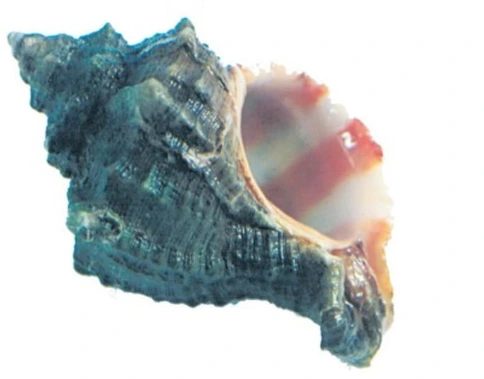
Gentile scholars insisted that the Tchellet dye of the Torah is purple, not blue, that Jewish Tradition is flawed. However, the ancient unbroken Mesorah is that Tchellet is sky-blue, and therefore Rav Hertzog continued to search for a method to turn the dye blue.
Unfortunately, Rav Hertzog died in 1959 without an answer.
Over 25 years passed until a solution was found. In 1985, Sidney Edelstein, an American Proffeser visiting Israel, enlisted 2 proffesers to attempt to resolve the problem: Ehud Spanier & Otto Elsner. Due to the horrific smell produced from Murex dying, the latter was ejected from his lab by his fellow lab-mates. Being a cloudless sunny day, Elsner decided to continue his experiments outdoors. When he completed the process, however, the wool emerged a beautiful sky-blue. He had cracked the code. It turned out that leaving the mixture in the sun resulted in a blue dye instead of purple. To the ancient dyers, this was probably no secret.
Following Elsner's Discovery, much has been done to restore both the dying and the Mitzvah of Tchellet to Am Yisrael. Numerus articles, books, and multipal chemical analyses, have been published since. However, not too long ago, Tchellet still could only be found in a lab.
About a few years after Elsner's discovery, Rav Eliyahu Tavger began researching Tchellet. In 1988, his research culminated in the first dying of Tchellet in over a millenium. One pair he kept for himself, and the other he gave to his Chavruta - who refused, stating that the time hasn't come. 3 years later, he co-founded Ptil Tekhelet, which to date is the largest producer & distributer of Tchellet (which is where we happen to get our Tchellet:).
Proof for the Murex Trunculus as the Chilazon
Archeology
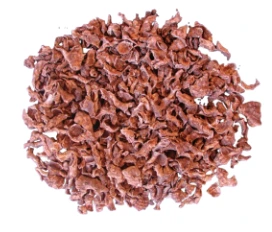
Mounds of Murex Shells have been found all over the Mediterranean, cracked in the exact spot needed to obtain the dyestuff.
Dying Vats have been found in these areas, dyed with what has chemically been proven as Murex Dye.
Talmudic Hints
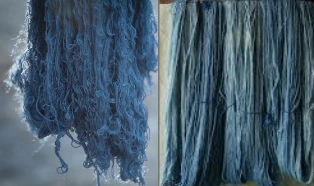
Murex Dye is incredibly similar to Kala Ilan (Indigo). The Talmud mentions these 2 dyes looking almost identical, and are impossible to be told apart by the naked eye.
The Talmud Yerushalmi calls the Tchellet Chilazon porphiron, similar to the Latin word for this snail.

Research
Extensive research has shown the Murex Trunculus to be the only sea-creature in the Mediteraniean sea capable of producing a blue dye.
More Archeology
Roman coins have been found with the Murex on it, testifying to the Romans pride in their Dying Industry.
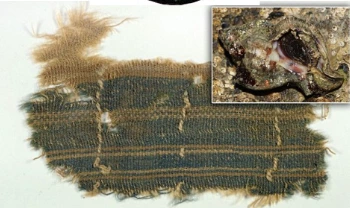
Futhermore, small peices of fabric have been uncovered in the Dead-Sea Caves, dyed blue, chemically proven to have been dyed by the Murex.